Sunday, May 17, 2020

Gibson Spurlock Feud


Patton Gibson fought in the Spanish/ American War company K unit 2 Sneedville, TN
12/14/1930, (Shot & killed in Indiana by John and Pleas Spurlock in revenge of killing their father in Virginia

VARDY PRESBYTERIAN CEMETERY

Patton Gibson Talley Collins   2/28/1888
1920 lived Bell County, Ky., Calloway.. Amanda Barnes age 38 , housekeeper

Some time before 1930, Patton Gibson supposedly killed John Spurlock in Lee County, Virginia. This was within a few miles of  Hancock County's Vardy community. John Spurlock's sons ended up shooting and killing at least two other Gibson family members, one of whom went to Washington County, Indiana (reason unknown - perhaps to escape retribution???) where he was shot down on the court house steps. Some sources say this feud started over a woman.


ROW 8
 Patton Gibson, 3/12/1870-12/14/1930, (Shot & killed in Indiana)
 Tallie Gibson, 1879-1919, nee Collins, (TB)
 Martha Gibson, 1902-1908,

ROW 7
 Odie Gibson, 3/4/1910-12/27/1930, shot & killed in Indiana
 Bradford Gibson, 10/2/1898-12/29/1928, (food poisoning)
 Hartman Gibson, Sgt. 2/16/1890-4/13/1921, (food poisoning)
 Hughie Gibson, 6/5/1896-6/14/1927, (food poisoning)
 Alonzo Gibson, 3/4/1934, shot & killed in Salem, Indiana
Patton Gibson fought in the Spanish/ American War company K unit 2 Sneedville, TN
12/14/1930, (Shot & killed in Indiana by John and Pleas Spurlock in revenge of killing their father in Virginia

Saturday, April 11, 2020

Gideon Gibson


GIDEON GIBSON


Gideon Gibson, Patriot, helped To Bring courts to Backcountry


Did you ever hear the story of Gideon Gibson of Mars Bluff and how the first circuit courts were established in South Carolina?  It's an old story which dates back before the war of the Revolution when this was a part of the South Carolina backcountry and when all the colonies were subjects of the British crown.

The year was 1750 and the only court of civil and criminal jurisdiction was in Charleston, except the courts of justices of the peace which had jurisdiction only in civil cases as high as 20 pounds current money.  The result was a great handicap upon the people wo lived some distance from Charleston, as did the people of this or any other section of the Peedee.  Roads and ferries were few, and even short distances were therefore extremely great.  According to Bishop Gregg in his HISTORY OF THE OLD CHERAWS the people were "worn out by the law's delays, insulted by the insolence of office and ruined by costs and expenses most unreasonably incurred and cruelly exacted."

But that wasn't the greatest evil.  Because the Court of Justice was too far away to carry small offenders to it, petty disorder became common place and a scourge to decent, law-abiding citizens.

Under these conditions the South Carolina Regulators, similar to the Red Shirts [See Wade Hampton's Red Shirts   - *See Hampton's Legion below]  of a later day, came into being and Gideon Gibson of Mars Bluff was one of the foremost of them.

In the year 1752, the inhabitants of the Pee Dee about the mouth of Lynches Creek filed a petition, stating that they had to travel about 200 miles to the seat of government, that trade and commerce among them were greatly obstructed for want of a county court to hear and  determine all causes, civil as well as criminal; 'that the frontier is same back country, had become a dwelling place of many evil disposed persons, such as horse thieves and other felons who had escaped from North Carolina and other parts, others co-habitating  with their neighbors wives and living in a most lascivious manner, while they had no means to suppress them.  They requested that an act be passed dividing Craven County which included all this section of South Carolina, and that their section, which by their own description would have included what is now Florence County, be established as a distinct county with 12 or more justices authorized to hear and determine all cases without fee or reward.

But they didn't get their county. The committee named by the council to consider the matter ruled that since there were no fit towns for the establishment of a seat of county government in the territory indicated, no such county should be established but that instead a court should be established at Georgetown for the greater convenience of the people.  The court at Georgetown was, however, not established and the inconveniences to the people of the back country continued.  For nearly half a century this condition prevailed.  The Regulators organization was composed of a high type of citizen.  Their aim was to suppress the disturbers of the peace by promising speedy punishment to them.  They had asked for the establishment of a court and had been refused.  They now sought the regulation of their difficulties by this armed organization called the Regulators.  The government, of course, sought to suppress them.

Again in 1767 a petition went from the upper and interior parts of Craven County to the government for a redress of grievances.  And still again in 1768, another petition went citing the grievances of the people and urgently requisition that the government give to them the consideration and conform to the wishes of the people for a court nearer than the distant Charleston.  The request was summarily disposed of by the Council, to use their own words, "after mature deliberation, by determining that I would not be necessary to take any notice of the same"

It was here that Gideon Gibson stepped into the picture.  In less than a month after the final rejection of the petition by the Council, Gibson had advanced a type of argument the government could not ignore.  He was a man of property and influence whose home was near Mars Bluff.  He was a man also of fierce determination, an acknowledged leader of the people who was "as he was intent upon vindicating the rights of the people."  A magistrate by the name of Weaver; issued a warrant of distress to execute on the chattels of some of the Regulators, and a constable, George Thompson, called in 13 other men to assist him.  Gideon Gibson arose to meet the challenge.  He was the leader of the Regulators, and he and his band met the constable's party near Mars Bluff in a pitched battle.  One of the constable's men was killed and Gibson's brother was wounded.

The government was alarmed.  Gideon Gibson had made more impression upon the hard-headed government heads in Charleston than had the petitions signed by many of the people.  He had attacked the problem direct, with the supporting power of gunpowder.  The government did not understand, and didn't try to understand that the Regulators were men of fierce patriotism, law abiding, fair minded citizens who had taken arms only after they had exhausted all means of getting much needed relief by peaceful methods.  An order was issued that they disperse and return to their homes, promising "His Majesty's gracious pardon for the misdemeanors committed, excepting those person concerned in the outrages and daring violence committed by Gideon Gibson and other upon George Thompson, a lawful constable."

In the meantime, Governor William Bull sent a Colonel Powell, who belonged to the Pee Dee Regiment of His Majesty's militia to Mars Bluff, they found 15 men of Captain Weaver's company, and the day following they were reinforced by 20 others.  But they heard disturbing things from the people around Mars Bluff.  Gibson, they were told, was guarded by a large company of men, and if he'd just speak the word, he could easily get 300 more within an hour's time.  As Colonel Powell listened to these reports from the people of Mars Bluff, he saw the need for more reinforcements, and so he sent orders to five company captains to join him at Mars Bluff with 20 men from each of their companies to assist in taking Gideon Gibson.

In the meantime, Colonel Powell had been told that Gibson would surrender himself, so Powell sent a letter to Gibson inviting him to meet with him in the woods where they might be alone and talk the matter over.  The meeting day was Sunday and for an hour and a half the two men talked and reasoned together.  Powell knew he had the power of the government behind him, while Gibson knew that behind him was the power of right and the people.  The outcome of the conference was a promise from Gibson that on the next day at 8 o'clock; he would surrender himself at an appointed place to Mr. Pinckney, the provost marshal. When the time for his surrender came, Gibson was not there .  Instead, he had sent a letter which explained that since the agreement made on the previous day, he had altered his decision and would not surrender.

The 100 reinforcements Powell had ordered from the five companies  had not arrived and Powell was becoming anxious.  But by noon they did arrive and drew themselves up about a half mile from the home of Captain Weaver. Colonel Powell and Provost Marshal Pinckney went immediately to meet them, but upon their arrival they found  instead of 100 men as requested, about 300 or more.

Colonel Powell stood before them and immediately  began declaring what was expected of them, Gibson was to be taken, dead or alive.  His followers, the Pee Dee Regulators who had defied the government, were to be destroyed.  Resistance to the government must come to an end.  His Majesty had proclaimed it, and he read the proclamation in their hearing.

Powell was their commanding officer and had a right to expect obedience of them, but the men had their own speech to make.  Gideon Gibson, they said, was one of them and had sought their protection, and protect him they would.  They began a recitation of the evils to which the absence of county courts had subjected them.  Here were a people who understood the meaning of justice defying a government which refused that justice.  In the subsequent fight for independence, many a brave act was to take place within the deep shadows of Pee Dee swamps, but there in the woods in the Mars Bluff community during the days prior to the revolution, were sons of the Pee Dee committing a act comparable in courage to anything that Marion and his men did during the days of the Revolution itself.

While a commanding officer has a command which will not take orders from him, he must either exercise severe discipline or remove himself from the command.  The former Colonel Powell was in no position to do the first, so he chose the latter.  "I cannot with any propriety," he wrote the governor, "continue to be colonel of a regiment of militia amongst whom I have the mortification to find myself of so little weight  as not to have been able to persuade them to do the duty they owe to their King and Country."

And so, Gideon Gibson, patriot of the Pee Dee, came forth from his hiding into the hands of his friends, and Colonel Powell, the commanding officer of the militia, was powerless to get the militia to lay hands upon him.

Less than one year later, the bill for the establishment of the circuit courts became law, and the people of the Pee Dee no longer had to go to Charleston to get their grievances settled in a court of justice.

And that's the story of Gideon Gibson, a Pee Dee patriot, of colonial days, and how the circuit courts came to the south Carolina backcountry.

Note; Material for this story was found in Gregg's HISTORY OF THE OLD CHERAWS and in a paper prepared by Miss Nellie Bristow of Florence and appearing in the Florence Morning News under date of June 19, 1938.


Charlestown, (S. Carolina) August 16
(News Article)
Date: 1768-10-13;
Paper: New-York Journal
Charlestown (S Carolina) August 16th
" The outrageous opposition lately offered to the Civil authority near Mars Bluff, on Pedee River, being at present a general subject of conversation, and by many attributed to the People called Regulators, it may not be amiss to lay before the public the following information, viz. : That there are two parties so called, and the proceedings of the one frequently confounded with those of the other. That the first (called the Honest. party) consists in general of people of good principals
 and that the other (called the Rogues' party) are a gang of banditti, a numerous collection of outcast Mulattoes, Mustees, Free Negroes, &c., all horse thieves from the borders of Virginia and other Northern Colonies (the very people whom the Regulators would have expelled the Province, or brought to Justice), and have taken up arms to carry on their villainy with impunity. The last accounts we have received of both are, That the former, on the 16 th past, took up one Charles Sparks, of infamous character, on Pedee, and ordered him to receive 500 lashes and quit the Province : and of the latter, that an armed company of them, headed by one Gideon Gibson, on the 25th past, near Mars-bluff, surrounded a Constable and 12 men, who were sent to bring one of the villains before a magistrate, and after a smart skirmish, wherein two of the Constable's party were mortally wounded, and one shot through the shoulder, took the rest prisoners, whom he discharged, after ordering them 50 lashes each. In the skirmish, Gibson had one of his sons killed, and another wounded in the neck. Proper measures are taken to bring the principals of this desperate Gang to Justice.


New York Journal
September 15, 1768
Charlestown, (S Carolina) August 19th
On Saturday the 6th Inst. his Honour the Leiut. Governor, by and with the advice of his Majesty's hounourabl council, issued a Proclamation, wherein, after reciting that of the 3d inst. and setting forth, that it had been represented and appeared to his Houour, that very many Person concerned in the acts of Violence, committed in the Northern Parts of this Province, had been unwarily drawn in and provoked thereto, by the great and repeated Losses they had sustained from Gangs of Robbers and Banditti, confederated in numerous Bodies; all Persons, unlawful assembled, are strictly commanded to disperse and repair peaceably to their respective Houses and Occupations; the, and all others, are also forbidden thereafter to assemble again , at their utmost Peril.  The Proclamation concludes with a promise, for all such as shall forthwith pay a due obedience thereto of his Majesty's most gracious Pardon, for all Misdemeanors by them committed, previous to the 6th Day of August Inst in unlawful assembling, Whipping or confining an Person or Persons, as set forth in the Proclamation of the 3d, excepting to Gideon Gibson and others who attacked a Constable and hi Party in the actual Execution of a legal Warrant, near Marr's Bluff the 25th Ult.-- It is with Pleasure we learn, that this lenient and human Measure is likely to produce the desired effect.


Date: October 13, 1768
Location: New York
Paper: New-York Journal
On the 22nd August, the Gazette said : " We are sorry that we cannot have the pleasure of informing the public, that either of the Proclamations issued by his Honor the Lieu* Gov r on the 3rd and 6th insta, are likely to produce the desired effects; Gideon Gibson declining to surrender on any terms; having put himself under the protection of people that do not at present seem disposed to give him up. This man's character, we are told, always stood fair, till he lately became the tool of a Party, who committed the outrages near Mars-bluff, mentioned in our last."


*HORNELLSVILLE WEEKLY TRIBUNE
[New York]

11/28/1890

SOUTH CAROLINA’S REDBONES
 There are a singular race of people in South Carolina called the Redbones. Their origin is unknown. They resemble in appearance the gypsies, but in complexion they are red. They have accumulated considerable property and are industrious and peaceable. They live in small settlements at the foot of the mountains and associated with none but their own race. They are a proud and high spirited people. Caste is very strong among them. They enjoy life, visit the watering places and mountain resorts, but eat by themselves and keep by themselves. When the war broke out several of them enlisted in the Hampton legion, and when the legion reached Virginia there was a great outcry among the Virginians and the troops from other states because we had enlisted Negroes. They did not resemble the African in the least, except in cases where Africans had amalgamated with Indians. This intermixture, which is common in the Carolinas, produces marvelous results. It takes the kink out of the hair of the African, straightens his features and improve him in every way except in temper---Interview with Senator Hampton.-------------


Tuesday, August 28, 2018

Valentine Gibson


Partial List of Tithables  Deep and Flatt Creeks Amelia County Virginia, 1745

22 August 1751 O. S., Page 353Ordered that William Thurman, Richard Thurman, John May, Richard Bennett, James Bennett, James Nicks, James Doss, John Shinnaison, William Roberts, Valentin Gibson, Elisha Lyon, Edward Nicks, James Lax, Benjamin Nicks, William Nicks and Valentine Nicks Work on the Road that James Nicks is Surveyor of.
22 August 1751 O. S., Page 350 Ordered that James Nicks be appointed overseer of the Road from the Ridge at the Head of Appomattox River joining of Callaway's Road the best Way to where it Crosses the Said River 


Skinquarter is an unincorporated town located off U.S. Route 360 in the western part of Chesterfield County in Virginia. It is located on the headwaters off Goode's Creek and Skinquarter Creek which flow to different places on the Appomattox River. We have always considered Thomas who married Elizabeth Worley as a possible brother of Valentine mentioned in Thomas' will, we have no DNA connections to those Gibsons however Thomas was noted as raising a 'bastard child' in 1698. 


--------------------------------------------------------------------------------------------------


We have five Y DNA tests that prove Valentine's descendants but have not found Thomas, John, or William Robinson mentioned in Thomas' will.  Eunice Nicks, Frances Humphrey and Mary Brooks all show up in our autorsomal DNA.  

Eunice named her first son Valentine Gibson Nicks born about 1714 as he is a witness to a Bunch deed in 1734, Valentine born in 1723  would seem to indicate Thomas' wife or mother was from the Valentine/Garret families.  


Tuesday, May 31, 2016

William K. Gibson - Three Families

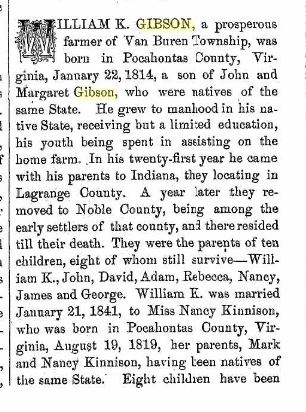
William K. Gibson born 1814 in Stokes County, North Carolina  married Polly Gilliam in Scott County, Virginia in 1835 and removed to Morgan County, Kentucky where he and his wife raised their large family and died.  

He did not die in Indiana in 1888 and he is not the son of James Gibson and Jane Dowdle. as you will see below.

Furthermore William K. Gibson son of James and Jane Dowdle did not die in Indiana in 1888, he was not born in 1814 and he did not marry Nancy Kinnison.  That William K. Gibson born 1814 was son of John and Margaret Gibson of Pocahantas, Virginia who removed to Noble County, Indiana. 


The third William K. Gibson who is often confused with the above two William Gibsons was born in 1830 in Giles County, Tennessee, he is the son of JAMES AND JANE DOWDLE.  That Gibson family went from Giles County, Tennessee to Lawrence/Barry County, Missiouri and was never in Morgan Co., Kentucky or in Indiana.  

If you have the wrong families connected in your tree PLEASE PLEASE correct it. 


There are THREE William K. Gibsons.

  • William K. Gibson born 1814 in North Carolina married to Polly Gilliam in 1835 Scott County, Virginia, moved to Morgan County, Kentucky where both he and Polly died.  He was not married to Nancy and his parents were NOT James and Jane Dowdle, as we shall see.  This William K. Gibson is likely son of Ezekiel Gibson of Stokes County, North Carolina and grandson of Valentine Gibson. 

  • William K. Gibson born January 22, 1814 in Pocohantas County, Virginia to John and Margaret Gibson. He and his parents moved first to Lagrange and then to Noble County, Indiana where he married January 21, 1841 to Nancy Kinnison. He is not the son of James and Jane Dowdle as so many trees have attached him to that family and he is not the same man in Morgan County, Kentucky.  This is his tombstone below.  Note; He is son of JOHN AND MARGARET GIBSON of Pocohantas County, Virginia!

  • William K. Gibson born March 5, 1830 in Giles County, Tennessee. His parents were JAMES GIBSON AND JANE DOWDLE.  He did not go to Indiana, did not died in 1888, did not marry Nancy Kinneson or Polly Gilliam.  His grandfather, George Gibson and son James came from Guilford County, North Carolina to Giles County, Tennessee.  In 1836 James Gibson with wife Jane Dowdle [granddaughter of Governor Pickens of South Carolina with their family, including William K. Gibson removed to Lawrence County, Missouri.  He married Jane Lowder in 1853 in Lawrence County, Missouri. He was NOT married to Polly Gilliam, or Nancy Kinneson, he did not died in 1888 in Indiana and he did not die in Morgan County, Kentucky.

I hope these few records will straighen out these three William K. Gibson families.  I am a descendant of William K. Gibson and Polly Gilliam of Morgan County, Kentucky and I would like to see him attached to his real family.


This tombstone belongs to William K. Gibson son of John and Margaret of Pocohantas County.  

The wife, Polly, and all the children belong to William K. Gibson born Stokes County, North Carolina and died in Morgan County, Kentucky NOT INDIANA


----------------------------------------------------


------------------------------------------------------
This is William K. Gibson and wife Nancy who died in Indiana 


Saturday, March 7, 2015

George W Gibson - Jesse James


George Washington Gibson, born Morgan County, Kentucky, son of James Harvey Gibson and grandson of William K. Gibson and Polly Gilliam of Morgan County, Kentucky


Monday, February 23, 2015

Joel - Archibald - Ezekiel

On 26 May 1770 Thomas Gibson sold three tracts of land on the west side of Flat River "part of 606 acres which the sd. Thos. Gibson purchased of Earl Granville:" 100 acres to James Williams, 150 acres to George Gibson, and land to Joel Gibson [Source Paul Heinegg]   He received a grant for 150 acres in Wilkes County on the north side of Obed's Creek on the South Fork of New River on 3 November 1796 and sold 100 acres of this land on 18 January 1800 [DB A:142, 147]. He probably died about 1802 when (his son?) Joel sold land in this same area [Thomas Gibson who died in 1780 was either the brother of Joel or possibly his father.  If Joel sold Thomas' land on Obed's Creek then it is likely it was his brother Thomas who died in 1780 Henry County, Va., wife Mary and daughter Kezziah and Joel and his father bought land later in 1780.jp] 

5 November 1775  George Gibson Orange County will was proved in May 1776 (WB A:195)  He named his wife Mary. Mentioned but did not name his ''Sons and Daughters now living in the County" and provided for the schooling of his unnamed younger children. Joel Gibson and Lucrecy Collons were witnesses;  Sherwood Parrish and Thomas Gibson, Sr.,  executors.

10 June 1779 Lambeth Dodson entered 228 acres on Guilford County, North Carolina on 9 January 1779.  It was surveyed 10 June 1779 by Joshua Smith, with William Kellam and Joel Gibson acting as chain carriers  The grant was issued 1 March 1780, 228 acres below and in the fork of Mayo River, beginning at a poplar on the south bank of the North Fork of Mayo in the Virginia line, adjoining Joel Gibson and Philip Angling, and including the improvements of Thomas Gibson and Esaw Dodson.

January 1780 HENRY COUNTY, VIRGINIA Will Book ? pp30-31 Dated 3 January 1780 Probated 23 March 1780 To my loving wife Marey Gibson and my daughter Cuzziah Gibson my whole estate
Zackeriah King, Joel Gibson and Lambert Dotson executors.
Thomas (x) Gibson 
wit: Charles (x) More, Joseph (x) Nicols, William (x) More. 23 March 1780. Exhibited by Joel Gibson who gave bond with Lambeth Dodson and Champain Gibson as his securities.

1778 - William Moore  100 acres both sides Buffalo Branch of Mayo

[On 22 June 1765, according to the Pittsylvania County patent book, Lambeth patented 400 acres on the main fork of Mayo River which he transferred to George Gibson on 19 September 1766.]


1 Mar 1780  James BRISON 400 acres n the S side of Mayo River joining the sd River below the Mouth of Buffaloe Creek, both sides of [several] branches, and both sides of the sd Creek Opposite land of Joel Gibson and Andrew Gibson.
GRANT BOOK 33 2841 page 453


April 27, 1780; Thomas Gibson (inventory) appraised by Phillip Anglin, Danl. Goldsby, Lambeth Dodson; returned July 27, 1780.
1780 Joel Gibson was in Wilkes Co North Carolina on the New River where he and Thomas made land entries in 1780. [He owned and sold property on top of Peach Bottom Mountain in Wilkes Co. ]
--


9 June 1780   Thomas Gibson made a land entry on 9 June 1780 on Cranberry Path in Wilkes Co., N.C. This land was near the South Fork of New River in present day Ashe Co., N.C., entry # 1858 (Wilkes County, North Carolina, Land Entry Book 1778-1781)


page 79 258. Jan. 9, 1792 Robert NALL [written over ARCHIBALD GIBSON] enters 50 ac in Wilkes Co; border: a white oak at the head of a branch of Crambury Cr in "the" Low notch of "the" Big Ridge.

page 81 268. [no date] transfered to William REVES [Robert NALL- -lined out] enters 150 ac in Wilkes Co; border: George REAVES's line near where ANDREW GIPSON lived and runs down "the" river.
--------
page 104 365. Nov. 21, 1793 ARCHIBAL GIBSON [or ARCHIBALD GIPSON] enters 50 ac in Wilkes Co; border: at a white oak on the head of a branch of Crambury Cr in the low "knotch of the" bigg ridge and runs N.

21 Aug 1800 Volintin Collins entered 50 acres in Ashe Co on "Brushe" Creek, beginning on Joel Gibson's lower line and running down both sides of the creek. [Note Valentine said to have married Dicey Gibson - sister of Martin Gibson]

1800 - Joel, Archibald and Andrew Gibson listed as Slave Holders - Antebellum New River Valley - Ashe County   http://www.newrivernotes.com/ashe_enumerations_1800-1860_slaveholders.htm
--
29 Jan 1802 John Eller purchased 200 acres on Obids Creek from Joel Gibson paying 185 pounds for same. (Deed Book A, p. 213)

11 Aug 1800 Shephard Gibson entered 100 acres, beginning near the mouth of a"dreen" that makes into "Baire" Creek (Bear?) and runs up said creek.
11 Aug 1800 Shephard Gibson entered 50 acres beginning near Georg. Miller's lower line and runs down s. fork of New River.

SHERIFF'S SALES
Will be sold at Ashe Court House on Saturday the 18th day of June next to satisfy the taxes due for the year 1812, and the expence and cost of advertising the same.
50 acres of land of Archibald Gipson on Cranberry Creek


NORTH CAROLINA LAND GRANTS


[1795 Ambrose Collins entered 100 acres on Oba (Obeds?) Creek. #1913]


EZEKIEL & ARCHIBALD  More Here

Tuesday, February 10, 2015

Isaac Gibson

Isaac Gibson was born to Mahala Gibson on April 6th 1852 - no father


They are both on the 1860 census with John and Charity Gibson
Name: Cariety Gibson [Charity Gibson]
Age in 1860: 64
Birth Year: abt 1796
Birthplace: Virginia
Home in 1860: District, Letcher, Kentucky
Gender: Female
Post Office: Whitesburg
Value of real estate: View image
Household Members:
Name Age
John Gibson 64
Cariety Gibson 64
Jesse Gibson 21
Mahala Gibson 24 <------
Isaac Gibson 7 <---------
Matilda Gibson 6
David Gibson 18

Isaac married to Mrs Eliza Collins in Owsley County

Name: Isaac Gipson
Birth Date: 1853
Birthplace: Ky
Age: 24
Spouse's Name: Eliza J. Mrs. Collins
Spouse's Birth Date: 1848
Spouse's Birthplace: Tenn
Spouse's Age: 29
Event Date: 07 Dec 1877
Event Place: , Owsley, Kentucky


And here is marriage record where Eliza, dau of Charles and Oney Gibson married to Arthur Collins.
Name: Arthur Collins
Birth Date: 1844
Birthplace: Hancock Co, Tennessee
Age: 22
Spouse's Name: Eliza Jane Gibson
Spouse's Birth Date: 1845
Spouse's Birthplace: Lee Co, Virginia
Spouse's Age: 21
Event Date: 07 Aug 1866
Event Place: Lee County, Virginia
Father's Name: Martin Collins
Mother's Name: Eliz Collins
Spouse's Father's Name: Chas Gibson
Spouse's Mother's Name: Ona Gibson
Marital Status: Single
Spouse's Marital Status: Single
Indexing Project (Batch) Number: M86880-6 , System Origin: Virginia-EASy , GS Film number: 32441 , Reference ID: p14 #5

1870 Census - Arthur and Eliza
Name:Arthur Collins
Age in 1870:27
Birth Year:abt 1843
Birthplace:Hancock; TN
Home in 1870:Jonesville, Lee, Virginia
Race:White
Gender:Male
Post Office:Jonesville
Value of real estate:View image
Household Members:
NameAge
Arthur Collins27
Eliza J Collins24
Sophrona Collins2
Martin Collins60
Elizabeth Collins68

Eliza was the widow of Arthur Collins.
Here is Isaac and Mrs. Eliza Collins Gibson with the children of her husband Arthur Collins in 1880
Members:
Name Age
Isaac Gibson 37
Eliza J. Gibson 34
Sarah M. Gibson 3
William H. Gibson 3m
Cyphroney Collins 10
Louesia Collins 8
Cinthia A. Collins 8
Arthur Collins 5


Carla Ledford posted tombstones of Isaac and wife Eliza last month on the Gibson page


Howard Gibson is a direct descendant of Isaac Gibson, he does not match Gibsons --- he tested 12 markers and matches 22 TRENTS at 12 markers Zero Distance.